Posts

Showing posts with the label AASHTO

Soil Density Testing: 3 Test Methods

Image
  Soil compaction is an operation common to most construction projects and increases the strength and stability of soils to support earthworks, structures, and pavements. Techniques to achieve maximum soil density are well known, and the outcomes can be tested and quantified using standard methods. Soil material is placed in layers, or lifts, in depths from a few inches to a foot or more, and compaction equipment rolls, kneads, vibrates, or sometimes uses dead-weight to consolidate the soil. The Right Kind of Compaction Test Specifications for soil compaction are established during the design phase of the project and depend on both total loads anticipated and whether those loads will be static or dynamic. Judging the adequacy of compaction efforts using qualitative measurements like penetration resistance or observation of wheel traffic is not sufficient to determine if the specifications have been met. Standard Proctor specifications (ASTM  D698  / AASHTO  T 99 ) wo...

How To Do A Compaction Test Or In-Situ Density Test?

Image
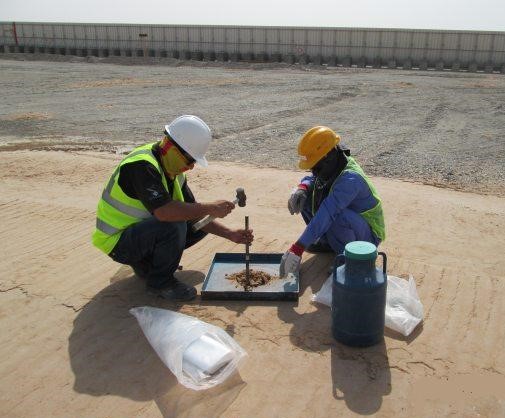
The consultant representative or the quality engineer shall select the area to be tested and shall mark on the drawing. There are many ways to determine the compaction of soil but widely being used  Sand Replacement Method ,  which we are using on our site. And before blinding works, you have to make sure that the inspection request is submitted to the consultant and compaction test report is passed. But first, here are the apparatus and equipment for the In-situ density test. Apparatus for In-Situ Density Test 1. Pouring Cylinder 7. Meter 2. Pointed Steel Rod 8. Hammer 3. Large Screw Driver 9. Bent spoon dibber 4. Sand or Silica Container 10. Gloves 5. Glass plate 11. Metal trays, 500mm square, 50mm depth with 200mm dia. hole in the center 6. Sample container (plastic bag or plastic container) Here are the procedure on how to do the  Compaction test  or  In-Situ Density test . 1. Place the metal tray.  The technician can now...

How To Calculate A Compaction Test Report?

Image
This is a continuation of the previous article I posted How to do a compaction test or In-situ density test, about calculation of the test report. Here we are going to compute the bulk density of sand down to the  degree of compaction  of soil. I would really want to pursue this article just to completely show the full process of getting the results of test from taking the samples into calculations. So every site engineer, project engineer, and consultant inspector, as well as engineering students should know how it is done. This would be a guide and help them learn the procedures. Here are the steps of calculations to determine the compaction test or In-situ density test report. 1. Compute the Bulk Density of sand. The calculation of bulk density of sand shall be made in the laboratory before moving on to the site. Here are the values tabulated below. Values taken from the laboratory V 0.00785 m³ Volume of calibrating container M1 17,050 gm Mas...