Posts

Showing posts with the label Soil

Soil Testing - BS 1377 - 1990

Image
Soil Testing - BS 1377 Parts 1-8 1990 The laboratory provides a modern temperature controlled effective stress laboratory offering the standard range of drained or undrained triaxial effective stress and permeability tests together with many of the advanced tests now commonly being required. Facilities also exist for determination of direct shear and one-dimensional consolidation properties using the oedometer. BS 1377 Part 2 Moisture Content Particle Size Distribution Sedimentation Atterburg Limits Linear Shrinkage BS 1377 Part 3 Sulphate Content (aqueous) Sulphate Content (Total) Organic matter content pH Value Chloride Content BRE Suite BS 1377 Part 4 Dry density/ Moisture Relationship MCV One Point/Calibration Vane Shear Bulk Density- Compacted Bulk Density- uncompacted California Bearing Ratio Test BS 1377 Part 5 Determination of the one Dimensional Consolidation Permeabilty test by Constant Head Permeabilty by the Ken Head Method...

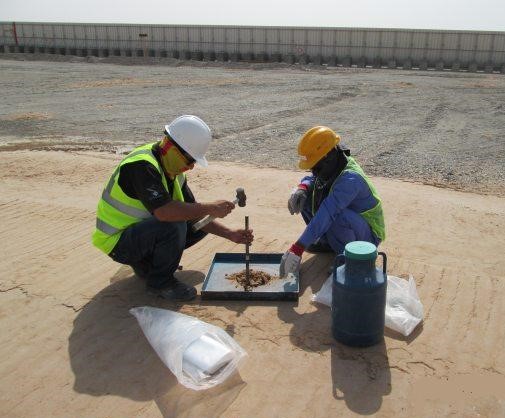
How To Do A Compaction Test Or In-Situ Density Test?

Image
The consultant representative or the quality engineer shall select the area to be tested and shall mark on the drawing. There are many ways to determine the compaction of soil but widely being used  Sand Replacement Method ,  which we are using on our site. And before blinding works, you have to make sure that the inspection request is submitted to the consultant and compaction test report is passed. But first, here are the apparatus and equipment for the In-situ density test. Apparatus for In-Situ Density Test 1. Pouring Cylinder 7. Meter 2. Pointed Steel Rod 8. Hammer 3. Large Screw Driver 9. Bent spoon dibber 4. Sand or Silica Container 10. Gloves 5. Glass plate 11. Metal trays, 500mm square, 50mm depth with 200mm dia. hole in the center 6. Sample container (plastic bag or plastic container) Here are the procedure on how to do the  Compaction test  or  In-Situ Density test . 1. Place the metal tray.  The technician can now...

How To Calculate A Compaction Test Report?

Image
This is a continuation of the previous article I posted How to do a compaction test or In-situ density test, about calculation of the test report. Here we are going to compute the bulk density of sand down to the  degree of compaction  of soil. I would really want to pursue this article just to completely show the full process of getting the results of test from taking the samples into calculations. So every site engineer, project engineer, and consultant inspector, as well as engineering students should know how it is done. This would be a guide and help them learn the procedures. Here are the steps of calculations to determine the compaction test or In-situ density test report. 1. Compute the Bulk Density of sand. The calculation of bulk density of sand shall be made in the laboratory before moving on to the site. Here are the values tabulated below. Values taken from the laboratory V 0.00785 m³ Volume of calibrating container M1 17,050 gm Mas...

Soil Compaction Tests

Image
SOIL COMPACTION TESTS The main  differences between  the Soil  Compaction and the Consolidation  process are given below.  Compaction  is a process where mechanical pressure is used to compress the soil mass for the purpose of soil improvement.  Compaction is a  process  of increasing soil density and removing air, usually by mechanical means. The size of the individual soil particles does not change, neither is water removed. Purposeful compaction is intended to improve the strength and stiffness of soil.  In the consolidation  process, soil volume is reduced by squeezing out pore water from the saturated soil. TYPES OF COMPACTION: DEEP COMPACTION:  Dynamic compaction  is a method that is used to increase the density of the soil when certain subsurface constraints make other methods inappropriate. ... The process involves dropping a heavyweight repeatedly on the ground at regularly spaced intervals. SHALL...